
ELLIE O’NEILL
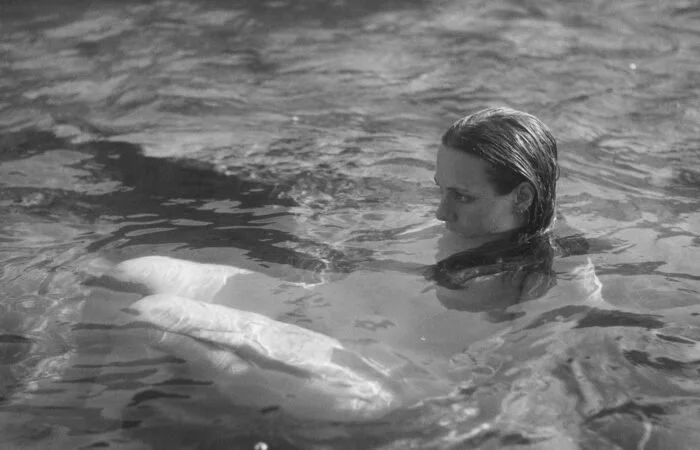
Co. Meath-born singer/songwriter Ellie O’Neill debuts her album ‘Time of Fallow’, which flows like water from a gentle yet persistent spring. O’Neill’s indie-folk writing style is as pure as a reflection in a rippling lake; within it there is no great strain for resolve, instead it tears vulnerability wide-open with astonishing purity. We sat down to chat about how O’Neill’s first album came into fruition, and, after years of creation, what it means to finally debut her first musical project.
How are you keeping?
Good. I just got off a flight from New York, so I feel crazy. But I will try to be very coherent.
I’m thrilled to see you’re coming out with your debut album. How does it feel?
It feels good. It’s time. It’s been a long time in the works.
Was this album a type of lockdown project?
I suppose we did the recording during lockdown. We did it in 2021. But I had written some of it before that stage and then wrote some of it during the recording. It was kind of an ongoing thing. I wouldn’t say it was necessarily a lockdown album because I had written a good few of the songs before. Some of the songs on the record are quite old but I feel like they’ve stood the test of time. In my world, anyway.
What was the first song that you wrote for the album?
Witness. It’s towards the end of the album. That’s the first song I wrote fully for it. I wrote it in like twenty minutes after a long period of not writing at all, so it was a brilliant feeling. It’s one of the first ones we recorded, I think maybe the first that we recorded for the album as well.
Do you still feel like the songs resonate with you emotionally, even though some of them were written a good few years ago?
I think that they’re like these rolling stones that collect meanings as they live. And I’ve played a lot of gigs. I play live quite regularly. I feel really comfortable doing that. It’s very normal to me. So, I think the songs have this other life that is separate from the recorded material. Sometimes if I’m tired [while playing] or whatever I might not feel them as much, but I always seem to find a new favourite or gain a new meaning from them. I think that’s an important thing for me- that the song stays with me through time. Then it becomes something else that isn’t just a song. It’s like lodged in me, or something. And I move through it. So, thankfully, I’m not turned off by them. I always think about songs that I love and wonder if other artists get sick of their songs. But I feel like if the song is meant to last, it will.
A standout track for me on the album is ‘Seán Song’. Can you tell me what that song is about?
It’s about a dream that somebody told me about. It’s sort of a first encounter with someone as well. I wrote it really quickly while we were recording. It has this dreamlike quality to it, but it also has a form that maybe I don’t have in a lot of my other songs. I can see it, when I’m playing it, it’s like a mountain. Like you go up, you get to the peak, and then you come back down, and it’s the same on the way back down. It’s like this sort of endless thing that could go on forever because you could go to the peak over and over again. It’s like a mirror. And I think the form of the mirror is relevant to the meaning of the song as well.
Was it important for you to become comfortable playing a lot of live sets before releasing your debut album, or did it happen naturally at this time of your life to release it?
I’ve definitely had a whole lifetime of playing gigs before any of those songs were written. Playing live just feels like a really normal part of my life, and it’s something I really love to do, which is quite surprising because I’m not necessarily a very loud person. But I do, I just love that moment of playing live and everybody being there. Like the communal moment of any live performance is so brilliant to me.
I think playing live was just something that I’ve always done and something that makes me feel present; something that grounds me, teaches me things in the moment about myself.
It’s funny, I never really thought about making an album. I was just a teenager that wrote songs and then I just continued to do that into my twenties. Whenever my friends were making albums, I was like, “That’s crazy, we can do that” So, then I guess I thought, maybe I could do that. And then whenever I had an opportunity to make it, I was like “let’s do this.”
When you’re writing songs, you take on the position of a narrator in a lot of them. Does it feel like a release to be able to play around with time and temporality in your writing?
Yeah, definitely. I mean, to me, any artwork that refuses the faux coloniser definition of time as a straight line is really good. It’s a really freeing thing to understand that time doesn’t operate like that. It also helps me make sense of the world to hold the belief that everything that’s happening now is always happening. And that can give you power for change.
In terms of songwriting, it’s like stepping into the sea of everything. You can just step into it. And that, to me, is more true than linearity. It was definitely not a conscious thing, but it’s like a little key that unlocked a lot of songs for me was to understand that.
Also I love to read different types of literature that operate on those [frameworks] you know, queer time, anti-colonial time. Really, the real way to understand time, I think.
Do you think that method of writing songs emerged because of other works you surrounded yourself with?
It’s that to an extent, but I think it’s also about me- like the writer part of me- being able to get into the stream. Which is like a totally unconscious decision. And obviously the unconscious doesn’t operate linearly either. I think that’s where things that feel real to me come from. Or maybe that’s just the jet lag talking.
Is there a letting go of control involved now that the songs are being published in a work by themselves?
I don’t think this is the moment for me to feel that. I think it’s funny, the idea of being in control, because I actually think the songs exist and appear and are formed whenever control isn’t involved, for me. I know that there’s a lot of people who make work in the opposite way, by leaning into the discipline of control, but I think for me it’s the opposite. It’s actually more freeing. It’s a sense of freedom that makes the songs happen in the first place.
I don’t know how I’m going to feel when the album is actually out. I supposed I have released a good chunk of them already and I’ve already played most of them live so they already have lived that life as well. I can’t really know how I’m going to feel… but I bet I’ll feel good.
Ellie O’Neill plays at Bello Bar on Friday, the 10th of April, as well as a string of shows later in the month in London, Manchester and Leeds. Time of Fallow is out now and is available on all streaming platforms. For more information on physical copies of the CD, limited vinyl pressing, or concert dates, see ellieoneill.bandcamp.com.
Words: Leanne Gleeson